- Home
- Research
- Shared Resources and Core Facilities
- Biospecimen

The Biospecimen Shared Resource (BSR), directed by Andrew K. Godwin, PhD, is a core component of The University of Kansas Cancer Center's research infrastructure. Housed within the Biospecimen Repository Core Facility (BRCF) at the University of Kansas Medical Center, the BSR supports leading-edge translational research aimed at advancing cancer prevention, early detection, diagnosis, treatment and survivorship.
The team manages multiple registries comprising more than 74,500 participant enrollments. Among these are nearly 52,000 enrollments under the umbrella biospecimen protocol (HSC #5929; Godwin, PI), which supports the collection and management of:
In addition, 15,650 participants are consented for data-only participation, and over 7,200 participants are enrolled in investigator-initiated studies supported by the BSR. Through a partnership with the Department of Pathology, investigators also have access to more than 200,000 archival formalin-fixed, paraffin-embedded tissue specimens linked to clinical and pathological data.
Collectively, the BSR/BRCF team oversees one of the region’s most comprehensive biobanking resources, integrating biospecimens, clinical information and longitudinal follow-up data across multiple institutional repositories. These resources support a broad spectrum of translational and clinical research, accelerating discoveries in cancer biology, biomarker development, early detection, therapeutic innovation and precision medicine.
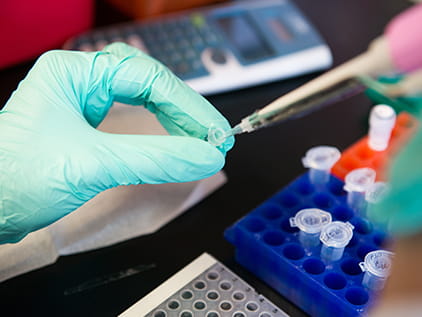
Researchers use biospecimens from participants to study how genes, lifestyle and environment may lead to cancer.
The BSR is fully equipped for biospecimen collection, processing, storage and distribution and adheres to National Cancer Institute Best Practices for Biospecimen Resources. Comprehensive standard operating procedures ensure specimen quality, consistency, and regulatory compliance throughout the biospecimen lifecycle.
The BSR also supports cancer center investigators who recruit specialized cohorts throughout the catchment area, including participants from rural and underserved communities. All biospecimens are linked to comprehensive, curated clinical databases maintained in collaboration with the Biostatistics and Informatics Shared Resource, enhancing the value of specimens for translational and population-based research.
As healthcare becomes more patient-centered, the BSR/BCRF plays a critical role in translating biospecimens into discoveries that improve prevention, diagnosis and treatment. Our participants are partners in every breakthrough. –Andrew K. Godwin, PhD
Director, Biospecimen Shared Resource


Advancing Triple-Negative Breast Cancer Research Through the P.R.O.G.E.C.T. Registry
The Biospecimen Shared Resource (BSR) played a key role in supporting a landmark study designed to create a comprehensive understanding of triple-negative breast cancer (TNBC). Led by Dr. Priyanka Sharma, the Prospective Registry of Outcomes with Genomic and Epidemiologic Characteristics of Triple-Negative Breast Cancer (P.R.O.G.E.C.T.) was established to collect detailed clinical data and paired biospecimens, including blood and tumor samples, from patients diagnosed with TNBC.
While many institutions collect blood specimens, few systematically gather both blood and tumor samples alongside well-characterized clinical information and prospective patient follow-up. The P.R.O.G.E.C.T. registry addresses this critical gap by integrating high-quality biospecimens with extensive clinical and epidemiologic data.
Drawing participants from multiple institutions and diverse clinical settings, the registry provides researchers with a broad and representative view of TNBC. With data and biospecimens from nearly 1,800 participants, P.R.O.G.E.C.T. (HSC # 12614; Sharma, PI) has become an invaluable resource for generating clinically relevant research questions and advancing our understanding of this aggressive breast cancer subtype.
Data and biospecimens from P.R.O.G.E.C.T. have supported four funded grants, informed the development of multiple clinical trials aimed at optimizing TNBC treatment and contributed to 51 breast cancer-related publications. By providing access to richly annotated biospecimens and longitudinal clinical data, the registry continues to accelerate discoveries that improve outcomes for people with triple-negative breast cancer.
This resource is funded by The University of Kansas Cancer Center Support Grant (CCSG) awarded by the National Cancer Institute (P30 CA168524). Publications that have utilized facility resources, services or scientific data generated by the resource should acknowledge the resource and cite the NCI CCSG grant.
To apply, click here. Applications are accepted throughout the year. Contact Lisa Harlan-Williams at lharlan-williams@kumc.edu for more information regarding membership.