- Home
- News Room
- Patient Stories
- How Gene Therapy and CAR T-Cell Therapy Are Changing Lives

September 14, 2026
When your own cells become medicine
For some patients, the future of medicine isn’t a pill. It’s their own cells. Two patients, one with sickle cell disease and one with a rare blood cancer, turned to The University of Kansas Cancer Center for answers.
First-in-the-world therapies, such as gene therapy, CAR T and other cellular therapies, are changing the face of cancer treatments. At The University of Kansas Cancer Center, doctors are using patients’ own cells to create powerful advanced treatments. “The results are spectacular. It’s changing the whole face of cancer medicine,” says Joseph McGuirk, DO.
That includes gene therapy for sickle cell disease as in Ian’s story and CAR T-cell therapy for blood cancers as in Emily’s story.
Ian’s story: The gift of time
From childhood on, Ian Wilhite has lived his entire life with sickle cell disease. Through it all, Ian graduated from college and law school, but the disease prevents him from working. “I take a lot of pride in what I do. I'm good at what I do, and this disease doesn't care what you do. It's going to attack, and it will be random and sporadic,” explains Ian.
In sickle cell disease, cells become hard and crescent-shaped, which causes them to stick in blood vessels, causing extreme pain. This pain can last hours, days or weeks. Which is why Ian traveled from Texas to Kansas City for the groundbreaking gene therapy CASGEVY® offered at The University of Kansas Health System. Sickle cell disease cuts lives short by decades. With CASGEVY, Ian would have a chance to live a normal life on his timeline. Ian shares, “I think the best part about this treatment is that it feels like I'm getting time back.”
Behind the scenes
The complex medical process takes months. First, Ian donates his blood. Then, a lab isolates his stem cells. His own genes are edited to remove the disease. Those corrected cells are then returned to his body. According to Ian, “It feels like I can slow down a little bit, and that I can just enjoy life a little bit more without fearing the worst.”
Turning the volume down
Ian has already noticed the pain volume has turned down. He now feels he has a real chance at a life free from debilitating pain. Ian reports, “The biggest thing I've noticed is that it's like the treatment kind of just turned down the volume on my pain. It used to be so intense. It used to be daily. It could be at an eight or a nine or a 10, and I can already start to notice that it just feels like everything got turned down. It's so much easier to deal with.”
Emily’s story: Hope from within
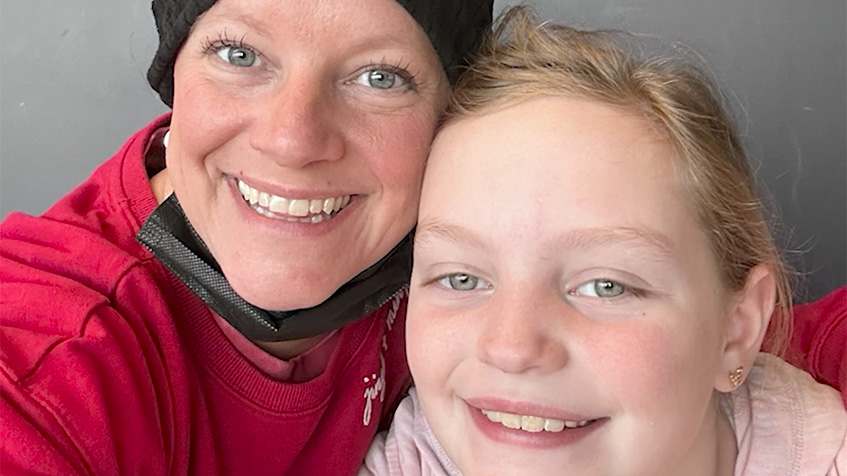
When Emily Schoeb was diagnosed with multiple myeloma shortly before her 40th birthday, her thoughts went straight to her 10-year-old daughter Amelia. “Getting a cancer diagnosis was not on my bingo card, and an absolute gut punch. My first thoughts were, I can't go anywhere because she needs me,” remembers Emily.
A rare and incurable blood cancer, Emily was started on several medications and prepared for a bone marrow transplant, which she received in 2025. After her transplant, Emily entered a two-year clinical trial as part of her treatment. Stem cell transplants are still the standard of care for patients like Emily, but clinical trials show the efficacy of CAR T-cell therapy.
The science behind the hope
CAR T-cell therapy genetically reengineers and changes important immune cells called T cells to recognize cancer. In the lab, T cells are taught how to recognize the cancer again. They are then expanded to hundreds of millions of cells and infused back into the patient.
What started out as a two-year prognosis, now has talk of a cure. One of Emily’s physicians, Joseph McGuirk, DO, says, “In patients with multiple myeloma, it's really a stunning therapy that's revolutionized the treatment of multiple myeloma.”
Even with the medical advancement of CAR T-cell therapy, there is a global crisis, especially in rural areas. The goal is to double the number of patients who receive CAR T-cell therapy by the year 2030. Clinical trials are part of this effort including another clinical trial that provides off-the-shelf CAR T-cell therapy. Unlike Emily’s treatment, which involves collecting the patient’s own cells and engineering them to recognize cancer and then infusing these cells back into the patient, off-the-shelf cells would have already been collected from someone else, engineered and frozen ahead of time.
Part of a bigger story
When asked about her role in the bigger story of cancer science and research, Emily answered selflessly, “I'm honored. Never in a million years would I have thought that getting a cancer diagnosis would be an honor … It's revolutionary. I feel so lucky to have been diagnosed with cancer when I did, and to have access to The University of Kansas Cancer Center … I feel so lucky and honored and excited to continue to be a part of it. Whatever I can do to help to get the news out and to spread the word.”

Real patient stories. Life-changing healthcare.
Choices, Hope and Science is a special 8-part series highlighting patient journeys, advancements in medicine and our dedicated clinicians partnering in treatment and recovery.