- Home
- News Room
- Patient Stories
- Students Support Athletic Director with Prostate Cancer

September 16, 2026
After learning their beloved athletic director Pat Butler had been diagnosed with metastatic prostate cancer, students and families across the Olathe school district found a way to turn a rivalry basketball game into something that mattered far beyond the final score.
Turning a night of competition into a community-wide show of support, the Olathe, Kansas, community ultimately raised more than $10,000 for The University of Kansas Cancer Center – all in Pat's name.
It was an outpouring he never anticipated. And one that is now helping fuel lifesaving cancer care for patients just like him.
The silent opponent
For more than 3 decades, Pat had been a steady presence across the 2 rival schools – first as an educator at Olathe Northwest, then as vice principal and athletic director at Olathe West.
Pat had always lived an active lifestyle, exercising regularly and coaching sports teams for years. When he began feeling run down and experiencing unexplained aches and pains, he sensed something wasn’t right and scheduled a doctor’s appointment.
His physician ordered a prostate-specific antigen (PSA) test, a blood test used to assess prostate health. The results were concerning enough to warrant further investigation.
Looking back, Pat admits routine physicals weren’t a priority for him because he generally felt healthy.
“I felt like I lived a pretty healthy lifestyle,” Pat says. “But as far as the routine checkups, I – like a lot of men – hadn’t done that maybe the way I should have.”
Pat was diagnosed with metastatic prostate cancer, with his doctors estimating the disease had likely been developing for a year or 2 before it was detected.
Known as the silent disease, prostate cancer often presents with few or no symptoms in its early stages, meaning it can progress significantly before noticeable warning signs emerge.
I so appreciated right off the bat this attitude of, 'We'll do this, and if this doesn't work, we'll do this.' I coached for a long time, and it felt very much like game planning … When we met with Dr. Knox, [he had] a calm approach and a very quick plan for how to attack this … That was very reassuring." Pat Butler
Putting together a game plan
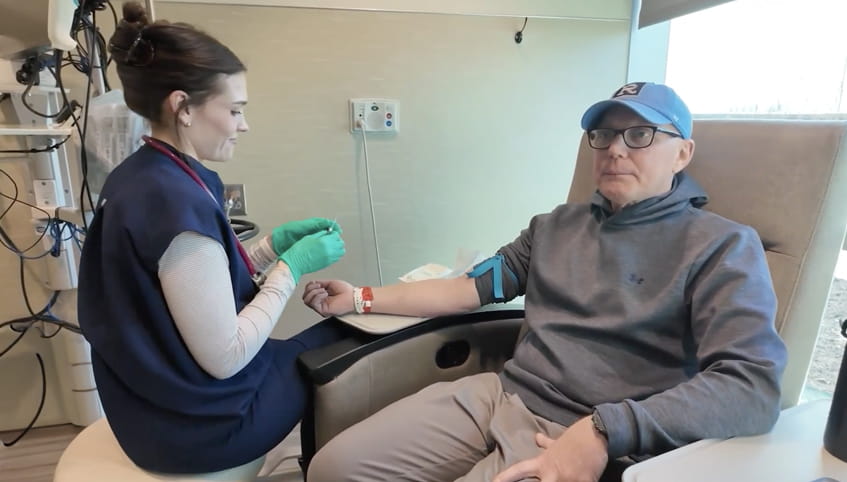
At The University of Kansas Cancer Center, Pat’s care team developed a specialized treatment plan, mapping out a course for how to treat his diagnosis.
This clear and adaptive approach immediately resonated with Pat.
"I so appreciated right off the bat this attitude of, 'We'll do this, and if this doesn't work, we'll do this,'" Pat says. "I coached for a long time, and it felt very much like game planning … When we met with Dr. Knox, [he had] a calm approach and a very quick plan for how to attack this … That was very reassuring.”
Cancer, like a tough opponent, doesn't always respond to the first approach. The key is having a proven, strategic game plan.
His care team, including Blaine Knox, MD, medical oncologist and hematologist at The University of Kansas Cancer Center and William Parker, MD, urologic oncologist at The University of Kansas Health System came prepared with exactly that kind of layered strategy.
Pat’s treatment plan includes 2 standard therapies for prostate cancer along with a third, more aggressive approach introduced upfront. This third component involved 6 rounds of chemotherapy over 18 weeks, designed to target cancer cells early and prevent them from later developing resistance.
While chemotherapy has long been used in cancer care, using it this early in prostate cancer treatment is a newer approach that has shown strong results.
“It’s been shown to be the best approach,” Dr. Knox explains. “Using all 3 up front, what we call triple therapy, you can really debulk the cancer and kill off those resistant cells.”
One Olathe
While cancer has brought uncertainty into Pat Butler’s life, it has also revealed an outpouring of support he never expected.
That support was on full display when the 2 schools he has been an educator at came together for a basketball game.
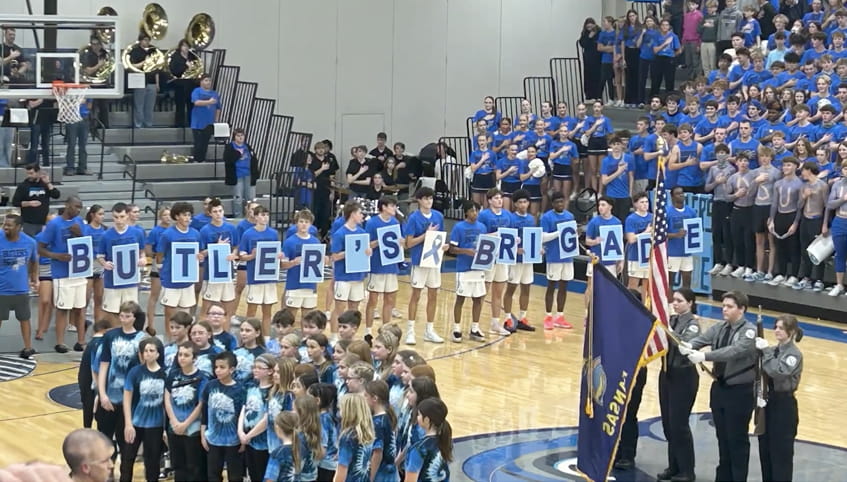
Usually rival teams, the rivalry took a backseat as students from both schools filled the gym in a sea of blue T-shirts that read “Butler’s Brigade” to show their support.
Signs throughout the crowd read “We Stand With You, Mr. Butler” and “One Olathe” – simple messages that reflected the spirit of a united community. The basketball game doubled as a fundraiser, with sales from the custom shirts helping raise funds.
A ripple effect spread throughout the Olathe community, as an Olathe Northwest soccer team organized its own fundraising event, with more groups quickly following suit. Across the Olathe community, more than $10,000 was raised for the cancer center.
Surrounded by support
"People are really good. That's what I've learned from this," Pat says. "Overwhelmingly, people have been amazing towards me and my family … [The community] was able to bring some attention to the issue and raise a little money.”
Support has been a constant through every step of his care. Having now finished chemotherapy, Pat has completed the most intensive phase of treatment. He has been responding well and now graduates to routine follow-ups every 3 months.
With 2 strong teams behind him (his medical care team and his Olathe community) Pat is moving through his diagnosis the same way he’s faced every other challenge: with a game plan and a team.

Pat Butler:
It's not really my deal to be the center of attention. I spent a lot of time there. It's special to me, obviously, thank you. But they were like, well, we're doing it.
Jessica Lovell:
It’s hard to tell kids no and the students at Olathe West High School are no exception.
Pat Butler:
These are the times that kids just rise to the occasion every time. I mean, I always tell people like, kids are about the same as they've always been. And they usually want to do good. And they want to please. And they want to be a part of things that are like this. And that's what's happened here.
Jessica Lovell:
Meet athletic director and assistant principal Pat Butler. He's been a popular fixture within the Olathe School District for the past 33 years, but it was his recent prostate cancer diagnosis when he found out just how loved he really is.
Pat Butler:
I was feeling a little run down more than normal. Started having some kind of different back pain and some pains in other areas that for a while I just associated to like being old.
Jessica Lovell:
Pat thought it might be a urinary tract infection or a hernia.
Pat Butler:
Then they did the PSA test, and it was very quickly obvious what was going on.
Jessica Lovell:
Although he said he had a pretty good diet and exercised, Pat admits he hadn't had a physical in a really long time.
Pat Butler:
You chat GPT stuff, and you're like, okay. It was pretty obvious what it was. And then we did some initial scans. And they were continuing to show what was quickly becoming obvious, that it was metastasized cancer.
Jessica Lovell:
Doctors at The University of Kansas Cancer Center confirmed it.
Pat Butler:
If I remember right, he said, you know, you've probably had this going on for a year, 2 years, and just kind of live with it. But I do look back now, and I think there was some symptoms that were there that I just was kind of just, you just live your life, you know, you just, like, kind of crank through it.
Jessica Lovell:
Doctors moved quickly and started Pat on 6 rounds of chemotherapy over 18 months and then put him on hormone blockers. He's responding well so far and will continue to get scans to check his progress.
Pat Butler:
I so appreciated, right off the bat, just sort of like this attitude of like, we'll do this, and if this doesn't work, we'll do this. I coached for a long time, and it felt very much like game planning. You know, like this is what we'll do in this situation. If that didn't work, we'll do this in this situation. And that helped a lot.
Jessica Lovell:
While Pat was busy getting better, his students were busy building a brigade, Butler's brigade.
Pat Butler:
They kind of capitalized the ad. So, you know, the athletic director ad part of my job, and it's a cool design with kind of barbed wire. And before long, the brigade grew. We played a basketball game, and the team we were playing their head coach was a guy who I coached a long time ago. He's now the head coach at Shawnee Mission Northwest. And their whole team and their whole coaching staff rolled in for the game to play us with the shirts on.
Jessica Lovell:
Pat was humbled by it all so much that he wanted to share the experience and the funds raised by the T-shirts with the cancer center.
Pat Butler:
I felt like, well, they're right here we I know tons of people that have gone through the same thing with KU. And, so I'm like, well, let's just raise some money and we'll take it over there. And so that's what we've been able to do. I went to Mizzou. So, the joke has been, this is like, the first time in my life, I'm like, let's go KU. But it's only for the cancer center. I don't want to go into any KU Athletics. That's been a little joke that we've made. It's been fun.
Gifts from our supporters make a vital impact on exceptional healthcare and medical research at The University of Kansas Cancer Center – the region’s only National Cancer Institute-designated comprehensive cancer center. Please reach out to us by email or contact one of our gift officers to learn more about how you can make a contribution.