- Home
- Research
- Research that Transforms
- Beyond the Bench
- Beyond the Bench 2025
- Breaking New Ground
Breaking New Ground

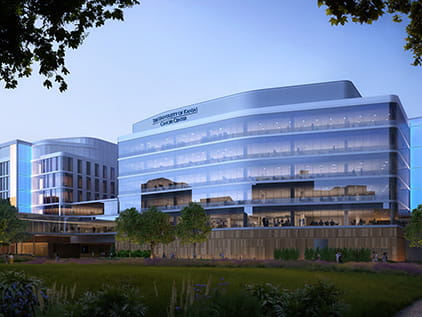
A new era in cancer research and patient care took a big step forward on a warm afternoon in May, as leaders, researchers, physicians and community supporters gathered at 39th Avenue and Rainbow Boulevard in Kansas City, Kansas, at the University of Kansas Medical Center campus to celebrate the groundbreaking of The University of Kansas Cancer Center’s newest facility. Scheduled to open in late 2027, the building will house laboratories, clinics and a Good Manufacturing Practice (GMP) manufacturing facility dedicated to one of the most promising frontiers in cancer research and care: cellular therapy.
Cellular therapy uses a patient’s own immune cells, which are modified and re-engineered to recognize and attack cancer cells. Immunotherapy treatments like CAR T-cell therapy have shown remarkable potential, offering options for people whose cancers no longer respond to standard-of-care treatments. However, only 30% of eligible patients nationwide can access these therapies today, in part because of limited access to manufacturing capacity at a national level.
“Cellular therapy has profoundly changed the way we treat some cancers, yet many patients who would benefit from these treatments don’t have access,” says Joseph McGuirk, DO, division director of the Hematologic Malignancies and Cellular Therapeutics program. “At The University of Kansas Cancer Center, we are working to increase access to these treatments for our patients. One of our strategies to increasing access is to expand our manufacturing capacity to produce these treatments locally.”
The new cancer center facility is designed to help close that gap. It is central to the cancer center’s vision for the future of cellular therapy, a roadmap built on five goals that connect discovery in the laboratory to clinical trials to patient care.
Roadmap to the Future
The plan is based on five interconnected goals. Together, they form a roadmap to move faster, reach more patients and ensure the work continues with the next generation of researchers.
“Cellular therapy is advancing rapidly, and The University of Kansas Cancer Center must be at the forefront,” says Roy Jensen, MD, vice chancellor and director of the cancer center. “These five goals give us a clear path to grow our research portfolio, strengthen our team and ensure patients have access to the therapies they need.”

1. Recruiting the Right People
Progress depends on people. To accelerate cellular therapy innovation, we are actively recruiting top-tier talent across all disciplines. This includes laboratory researchers who discover new therapeutic targets, bioengineers and laboratory technicians who refine how immune cells are re-engineered, physician-scientists who design the next clinical trials and clinicians who guide patients through treatment.
“The future of cellular therapy depends on the people we bring in today,” says Scott Weir, PharmD, PhD, who is helping spearhead the cellular therapy master plan and serves as director of the KU Medical Center’s Institute for Advancing Medical Innovation. “We are building a team with the expertise to lead transformative research.”
The future of cellular therapy depends on the people we bring in today. We are building a team with the expertise to lead transformative research. Scott Weir, PharmD, PhD
2. Building a Portfolio of Research
By 2030, the cancer center aims to move at least one new cell therapy into clinical trials every year. To get there, we need a robust portfolio of projects.
One example already underway is the Triple Threat trial. Unlike traditional CAR T-cell therapies that take aim at a single cancer target, the Triple Threat product contains T cells engineered to attack three distinct targets. This multi-target strategy reduces the chance of tumor escape or resistance, a common challenge in current therapies.
Participants in the trial are adults with B-cell non-Hodgkin lymphoma or B-cell acute lymphoblastic leukemia whose cancer has relapsed or did not respond to initial treatment. Researchers also plan to open a trial for children and adolescents up to 21 years of age in partnership with Children’s Mercy.
Developing such a therapy requires close coordination between experts. The ongoing adult phase 1 trial, led by Dr. McGuirk, demonstrates how a concept developed by scientists is translated into a novel treatment advanced to patients.
3. Manufacturing Cells In-House
To bring therapies from lab to patient, cellular therapies must be manufactured quickly with strict quality control. Right now, oncologists compete for limited manufacturing slots at designated manufacturing facilities throughout the US. Patients wait several weeks for their reengineered immune cells to be manufactured, tested for quality and sterility, and shipped to specialized medical centers to have them administered.
“The expansion of our GMP cellular therapy manufacturing facility and placement of this facility in the new cancer building are critical to the care of our patients,” says Sunil Abhyankar, MD, director of the Midwest Stem Cell Therapy Center and professor of Hematologic Malignancies and Cellular Therapeutics.
4. Expanding Access to Rural Communities
Only about a third of patients who would benefit from CAR T-cell therapy across the US actually receive the therapy. Limited access is also an issue in the cancer center’s catchment area, which encompasses the state of Kansas and western Missouri. Our goal is to double access to 60%. The plan includes telemedicine support, training for community providers and systems that let patients receive care closer to home while still having access to cancer center experts. For rural communities in Kansas and western Missouri, this initiative has the potential to significantly expand access to advanced therapies.
5. Training the Next Generation
The future of this work depends in part on people who aren’t here yet. The University of Kansas Cancer Center is developing education and mentorship programs to ensure that new researchers and clinicians are trained not just in basic science, but in translating laboratory discoveries into novel cellular therapy products, advancing these treatments to patients and incorporating new treatments into patient care.
Transdisciplinary Collaboration and Coordination
The Triple Threat trial offers a glimpse of what the future of cancer care could look like. Its multi-target engineering highlights both the complexity and promise of cellular therapies. Triple Threat shows how bold ideas in the lab can be translated into therapies in the clinic.
But breakthroughs require more than science. They depend on teams of basic, translational and clinician scientists that make the science work. From cancer biologists to regulatory experts to project managers to clinical study coordinators and data specialists, it takes an integrated infrastructure to bring these studies to life. Each step in the process requires close coordination across disciplines and organizations.
“Cell therapy trials are among the most complex we run – not because of the science, but because of the coordination it takes across clinical, lab and research teams. It’s a full-system effort,” explains Sandy Annis, BA, CCRP, executive director of clinical operations for cancer clinical trials. “This level of coordination is rare, and it’s what sets The University of Kansas Cancer Center apart. We don’t just run trials; we build the systems that make them successful.”
The new facility will give trials the space, technology and coordinated infrastructure they need to move from experimental concepts to treatments delivered reliably at the bedside.
Reimagining Cancer Care
The groundbreaking marks the start of the new facility, but more importantly, it sets the stage for discoveries that will redefine cancer care now and in the future. When the building opens in 2027, it will give The University of Kansas Cancer Center the capacity to move ideas like Triple Threat from concept to clinic, expand access across the region and prepare the next generation of leaders in the field.
“This new facility represents our commitment to discovering new therapies and ensuring patients across the region have access to them,” says Dr. Jensen. “The groundbreaking was just the beginning. The real breakthroughs will come from the work that happens inside.”
Building a future beyond cancer
Join us in transforming cancer care and research, and in making Kansas City a hub for world-class cancer care.